

Energy Resolution
Energy Resolution versus Count-Rate

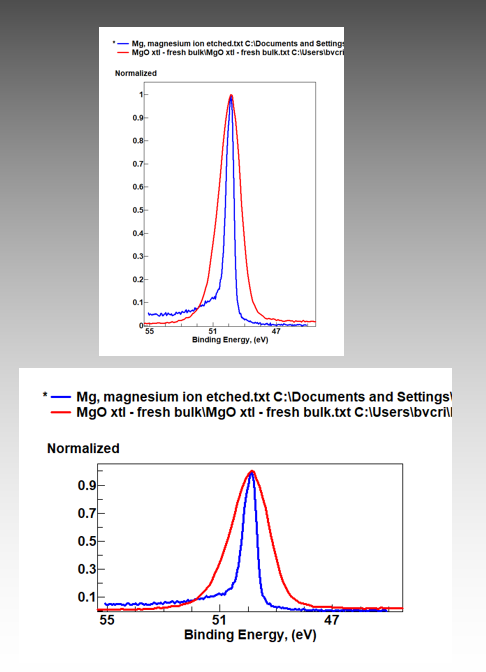
Natural FWHM of Metals < Natural FWHM of Metal Oxides
FWHM of Pure Element is normally ~2x smaller than the FWHM of the Pure Metal Oxide – This is not related to energy resolution or pass energy settings.
- Pure Metal FWHM range from 0.3 to ~1.3 eV for the main XPS signal
- Metal Oxide FWHM range from ~1.0 to ~1.8 eV for the main XPS signal
This is an overlay of the Mg (2p) spectra from pure ion etched Mg metal, and pure MgO single crystal (fresh exposed bulk).
The BE of the MgO spectrum was shifted ~2 eV to align the peak maxima of both signals.

FWHM of Chemical Compounds


FWHM of Pure Metals from XPS using Monochromatic and Non-Monochromatic X-rays


C (1s) FWHM from Poly-Butene Polymer at Different Pass Energies
PE = 200 eV, 50 eV, and 10 eV


- These 3 C (1s) peaks were measured from Poly-Butene by using three (3) different Pass Energies (PE) and then normalized to the same Peak Intensity.
- From this overlay, we see that the PE=200 eV pass energy gives the largest FWHM, ~ 2 eV.
- When the Pass Energy is changed from 200 eV, to 50 eV we see a significant decrease in the FWHM of this C (1s) peak. From ~2 to ~ 1 eV.
- But when the PE is decreased from 50 eV to 10 eV, there is almost no change. Why?
- The “natural FWHM” of any XPS signal is hidden under the instrument induced broadening of the natural FWHM.
- When the Pass Energy is small enough, the true “natural” FWHM appears and the FWHM will not decrease or decrease only very slightly when the Pass Energy is made smaller.
- For this peak the “natural FWHM” is visible when the PE = 50 eV. There was no advantage to use a PE <50 eV. Using smaller PEs, the electron count-rate drops dramatically and we waste our time. Using PE 50 – 90 eV gives a good count-rate and does not waste time.
- The FWHM of spectrum with PE=10 eV is not really the true natural FWHM. Various other artefacts need to be removed if you really need the true natural FWHM.
Why do we use different Pass Energies in an XPS Instrument? Typical Pass Energy Range: 5 eV to 300 eV
- XPS instruments measure Kinetic Energies (KEs) of Photoelectrons and convert those KEs into Binding Energies (BEs) within the range: 0 eV to 1487 eV. (for Al X-rays)
- Within that 1487 eV range of BEs, each element in the periodic table produces from 2 to 14 unique, characteristic XPS peaks (signals)
- The XPS signals for Hydrogen and Helium are extremely small, when using Al X-rays, so they are never observed by normal XPS analysis.
- When we want to know what elements are present or absent, we normally measure a “Survey Spectrum” to survey what elements are present or absent on that sample.
- When we collect a Survey Spectrum, we normally don’t want to waste time and want to measure high electron count-rates for all the elements on that sample.
- To achieve this goal, we use a large “Pass Energy” setting (PE=150-200 eV) which produces a large count-rate of photoelectrons but low energy resolution. A trade-off.
- When we collect Chemical State Spectra we normally need high energy resolution which resolves small binding energy differences between adjacent peaks for a specific element.
- To achieve this goal, we use a small to medium level “Pass Energy” setting (PE=50-90 eV) which produces the desired high energy resolution but produces low electron count-rate.
Instrument Design Factors
- XPS instruments are designed to collect photoelectrons by using different voltage settings on the electron collection lens, the electron analyzer, and electron detector.
- The electron analyzer is designed to use a range of “pass energies” (PE) from a typical maximum, PE=200 eV, to a typical minimum, PE=5 eV.
- Large PEs (150-200 eV) are used when we measure a “Survey Spectrum” to survey what elements are present or absent on that sample.
- Small PEs (50-90 eV) are used when we measure a set of “Chemical State Spectra” to resolve the different chemical states that exist for the elements of interest.
- When we use a large PE, the photoelectron count-rate is high, but the energy resolution is low. We use large PEs to measure Survey Spectra.
- When we use a small PE, the opposite is true. The energy resolution is high, but the photoelectron count-rate is low. We use small PEs to measure Chemical State Spectra.
- In general, the Peak-Width (FWHM) of principal key XPS signals decreases from ~ 2.0 eV to ~1.0 eV as the Pass Energy (PE) is decreased from a large value (150-200 eV) to a smaller value (50-90 eV).
- A few conductors and semi-conductors can produce principal key XPS signals having FWHM (Peak-width) as small as 0.3-0.5 eV by using PE=5-10 eV, but these are rare.
- When we use a PE=5-10 eV, we must collect many more scans that the usual 5-10 scans. Sometimes, one hour is needed. It is best to use PE=50-90 eV for chemical state spectra
A Zoomed view of the spectra shown above.
The peak BE max points do not perfectly align because BE depends slightly on Pass Energy which can be adjusted by an expert technician.


True Intensities from the 3 different Pass Energies (200, 50 and 10 eV). Not Normalized
- Three C (1s) spectra as measured, but NOT normalized.
- The peak area for PE = 200 eV (red line) is many times larger than the peak area for PE = 10 eV (blue line).
- The differences in peak intensities is due to PE only.
- PE=200 eV gives a very strong signal, but the FWHM is ~ 2 eV.
- PE=50 eV gives a signal that is ~5x smaller with a FWHM of ~ 1 eV.
- PE=10 eV gives a very weak signal that is >20X smaller than the PE=200 eV spectrum, and the FWHM is still ~1 eV.
- The time used to collect these 3 spectra was: 60 seconds, 300 seconds, and 1,800 seconds.

Results of Smoothing Spectra from the Cu (2p3) signal at 932 eV using 3 different Pass Energies
- Before Smoothing


- After Smoothing

