Energy Resolution of the XPS instrument depends on the settings applied to the hemi-spherical electron analyzer (HSA), pass energy, the electron collection lens, and electron detector. Energy resolution settings determine the FWHM of a photoelectron peak. Pass Energy settings applied to the HSA are the principal variable that controls energy resolution.
Energy resolution refers to the degree of monochromaticity within the energy range of the electrons that form a photoelectron peak of interest. Higher monochromaticity produces smaller FWHM in the peaks that result from peak-fitting chemical state spectra. For this reason, new instruments include Monochromatic X-ray Sources.
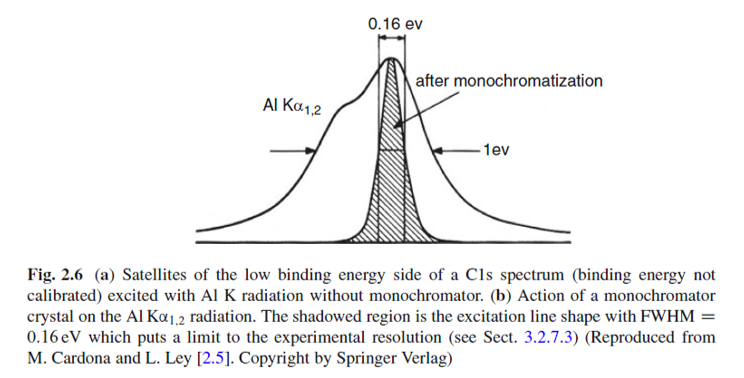
The energy resolution (FWHM) of the X-ray source is fixed for most XPS instruments. The energy resolution of a monochromatic Aluminum Kalpha X-ray source is 0.16 eV after it was monochromated by refracting from a natural quartz crystal.
FWHM of Aluminum K-alpha X-rays Before and After Monochromatization
The Full-Width-at-Half-of-Maximum (FWHM) of a peak is used to report the FWHM of any peak fited with a baseline. The FWHM of the Ag (3d5/2) photoelectron peak is normally used as the reference FWHM that reflects the working energy resolution of the instrument.
The silver sample needs to be ion etched clean before the Ag (3d5/2) photoelectron peak is measured from the peak-fitted chemical state spectrum. The resulting FWHM is used to define and report the Energy Resolution obtained by the analysis conditions used for a particular electron spectrum. This Ag (3d5/2) FWHM is published as a vital key part of the experimental details in literature publications.
For chemical compounds, the FWHM of peak-fitted peaks must be measured before any Argon ion etching of chemical compounds because etching often degrades chemical states of compounds which causes FWHM values to increase by as much as 2X due to defects introduced.
FWHM of photoelectron peaks from spectra of pure chemical elements are measured after Argon ion etching which removes metal oxides that have FWHM larger than the pure metal.
Small Pass Energy settings may have small energy resolution, but the natural chemistry of the most chemical compounds produce FWHM that are as much as 2X larger than the corresponding pure element.
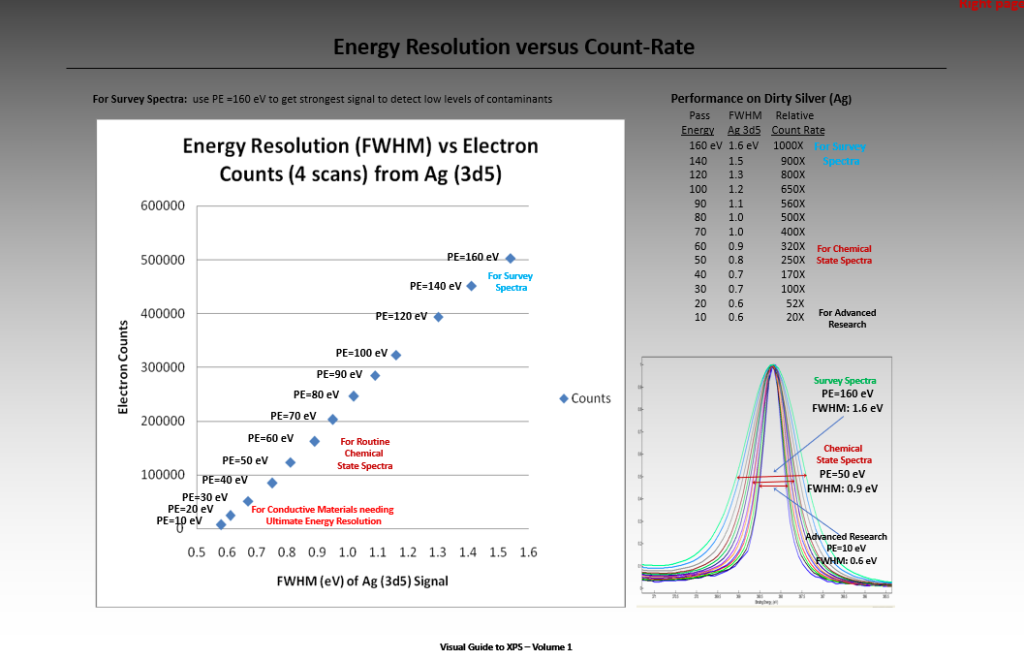
Small FWHM (eV) values are useful to resolve the presence of similar chemical states which appear as overlapping peaks in the peak-fit of a chemical state spectrum. Better energy resolution settings due to small pass energy settings have a drawback because the resulting electron countrate drops dramatically.
Energy Resolution results mainly depend on Pass Energy Settings
- Survey Spectrum Energy Resolution: FWHM (eV) for Ag (3d5/2) = 1.5 eV using Pass Energy = 150 eV
- Usual Chemical Compound Energy Resolution: FWHM (eV) for Main Peak = 1.0 – 1.2 eV using Pass Energy = 50 eV
- Chemical State Spectrum Energy Resolution: FWHM (eV) for Ag (3d5/2) = 0.75 eV using Pass Energy = 50 eV
- Ultimate Energy Resolution for a Conductor: FWHM (eV) for Re (4f7/2) = 0.35 eV using Pass Energy = 25 eV
- Ultimate Energy Resolution of Hemispherical Analyzer: FWHM (eV) = 0.25 eV using Pass Energy = 10 eV
- Theoretical FWHM (eV) of Monochromatic Al Kα X-rays: FWHM (eV) = 0.16 eV
Energy Resolution versus Electron Count-Rates
(higher energy resolution produces lower electron counts and weaker signals)
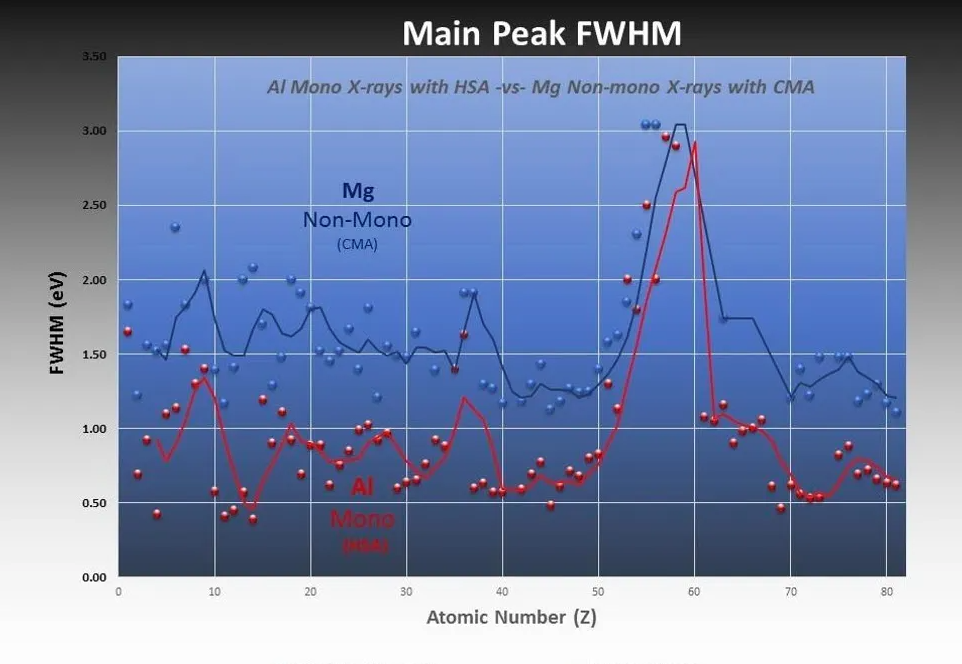
FWHM of Pure Metals from Monochromatic versus Non-Monochromatic X-rays