

The XPS Research Institute Inc. (501c3, NFP)
We are a team of skilled scientists and engineers dedicated to all things XPS.
Our Goal: To Improve the Reliability of XPS Information
- The XPS Research Institute (XRI) wishes to collaborate with XPS instrument manufacturers, university professors, industrial scientists, contract lab engineers, and government researchers around the world to develop and provide documented reliable methods and protocols, free of cost, to XPS instrument manufacturers, university professors, industrial scientists, contract lab engineers, and government researchers, who participate, contribute to, or donate to the XPS Research Institute.
- XRI wants to help all XPS scientists and engineers to produce more reliable BEs, atom% quantitation, chemical state assignments and interpretations.
- XRI is an international, scientific, non-profit research institute (501c3, DNP) that is dedicated to developing and providing new methods and new protocols that are needed, and are not currently produced or studied by international standards groups such as ISO, VAMAS, ASTM….
- XRI participants are dedicated to developing and providing new documented methods and protocols based on the list of “The Problems” listed below.
Our Story: XRI is New and Disruptive
-
- Our goals are to rejuvenate and enhance the reliability of XPS data and Information because many XPS users and scientists have found various significant problems with the XPS data that has been produced over the 50 year life of XPS use and publication.
- The problems are, in part, due to a lack of BE standards during the early growth years (1960-1990) of XPS. In 2000, ISO released its version of Calibration BEs, which users are free to use or not use. Their choice, which means that the problem is ongoing. Other types of persistent problems are listed below and elsewhere. Our CEO experienced these problems and other BE problems in 1984 after joining a contract lab called Surface Science Labs in the Silicon Valley. After moving to Japan in 1986 to work as a Demo (Applications) Engineer, our CEO began producing actual spectra to build a database of actual spectra to try to resolve various problems. Those efforts continue today here in XRI and at The XPS Library and The International XPS Database of XPS Reference Spectra.
- Today, when you review the current day (2023) literature, you find various Calibration BEs published in the Journal of Surface Science Spectra (JSSS), a peer reviewed journal, started in 1994, that publishes complete sets of actual XPS spectra as well as corresponding detailed instrument settings, calibration BEs, and analysis conditions aimed to help users. Unfortunately, when you review any issue of this journal you will find various pre-2000 calibration BEs and also post-2000 values. As you review some JSSS papers you will find the ISO calibration BEs listed, but there is no evidence that those ISO BEs were or were not recently measured. The BEs published are simply reproductions of the recommended ISO calibration BEs.
- This problem with calibration is just one of various problems that XPS users will find. This XRI website is dedicated to not only revealing our problems, but also to helping to develop methods and protocols that can be used from now. Sounds great! But the problem is complicated by people, who are called: authors, professors, lab managers, paper reviewers (who are not paid), and journal editors. These people need to take appropriate actions so that young professors, young managers, young reviewers and journal editors can publish data that is not only reliable, but even reproducible between different labs and on different XPS systems around our world.
Vision
-
- Our goals are ambitious, require team efforts, and international cooperation
- By improving XPS results the world can develop new materials for humanity
- By improving XPS results the world can improve the quality of existing materials for humanity
Our Purpose and Objectives are:
-
- To help XPS scientists to improve the reliability of chemical state assignments
- To help XPS authors to publish more reliable XPS BEs
- To work with XPS scientists around the world to make XPS information (more) reliable
- To help XPS authors, students, analysts, and scientists to improve peak-fitting skills
- To help XPS scientists to improve the reliability of quantitative results (atom %s)
- To work on the XPS problems listed below
- To expand the contents of “The XPS Library” website using contributions from XPS Scientists worldwide
- To add new raw spectra and processed spectra to “The International XPS Database of XPS Reference Spectra” website
- To develop on-line system to test XPS knowledge and instrument operation skills with certification
Limits and Issues of Common Analysis Methods, not just XPS
-
- Many analytical techniques measure just one analysis area on a sample just one time due to time and cost constraints
- Most XPS BEs are measured from a single spectrum and a single point on the sample.
- Non-monochromatic XPS sources cause heat induced degradation of various polymers, chemicals, and high oxidation state compounds
- Some instrument settings with modern monochromatic XPS sources can sample degradation during the actual analysis
- Some XPS instruments are very old with old electronics that might make it difficult to use the methods we develop
- XPS instruments use various geometries for the X-ray source and the electron collection lens
- The UHV available may affect the behavior of various samples
- Modern Flood Gun (charge compensation/neutralizers) can cause the loss of adventitious carbon during the analysis
- Very few materials are chemically degraded by the use of a flood gun (charge compensation)
Key Topics to Analyze and Resolve
-
- Reliability of XPS BEs in databases, old and future literature
- Working with journals, editors, reviewers, and authors to improve content of XPS publications
- Charge compensation (charge control)
- Charge referencing (charge correction)
- Valid peak-fitting parameters
- Chemical state assignments & Assigning chemical states logic
- Data interpretation
- SFs, RSFs, IMFPs, and quantitative atom%s
- Obvious Bad Peak-fitting must be removed by reviewers
- Moving sample in steps of 1 mm each during analysis to avoid degradation
Who is Responsible to Publish Reliable XPS Results
-
- Journals, Editors, and Authors are responsible to and expected publish Reliable XPS results
- XPS Instrument operators and lab managers need to check, maintain, and document calibration
- Author professors need to fully document XPS instrument parameters so that other scientists and engineers can reproduce their BEs
- Reviewers are not paid for their many hours
- Editors are not helping reviewers
Collaboration
-
- Round Robin testing is needed to determine utility of methods XPS instrument manufacturers, academic XPS labs, industrial labs, contract analysis labs, and government labs will collaborate as needed
- Discussion will be posted on line
- Funding is needed to pay for materials
Features & Symptoms of Our Mutual Problems (current situation)
- More than 80% of all samples are insulators that require charge compensation and charge referencing
- Roughly 90% of journal publications are produced by university professors and their poorly trained students
- A few XPS facilities use experienced XPS scientists to maintain an XPS instrument and help tens of students
- Eighty percent (80%) of BEs in NIST database are from Wagner’s collection of BEs collected from 1970-1990 by university students.
- BEs were and are still collected by university students who receive only a few days training from the last instrument operator
- Histograms of pure elements listed in Wagner’s (NIST) database show large dispersion and high standard deviations. BEs vary by +/- 0.4 eV
- Histograms of insulators listed in Wagner’s (NIST) database show large dispersion and large standard deviations. BEs vary by +/- 1.2 eV
- Wagner’s BEs are the same BEs that are published in NIST database, PHI handbooks, Seah’s handbook and others.
- Thousands of authors trust and use Wagner’s BEs because they are published in US NIST database and PHI handbooks.
- This means almost everyone is using Wagner’s collection of BE have large standard deviations
- Thousands of authors trust and used Wagner’s BEs because they are published in NIST database and PHI handbooks.
- From 1970 to 1990 BE Calibration was based mainly on BE of Ag (3d5) and Au (4f7). Cu (2p3) BE was almost never reported.
- Only 1 or 2 low BE calibration values from Ag or Au are reported in journals in today’s publication
- Many publications list the “expected” reference calibration BEs in a publication, they do not report “measured” calibration BEs
- Cu (2p3) BE (932.6 eV): A calibration energy appears at high BE end is almost never reported. Degrades BEs > 600 eV.
- Energy Scale ranges depended on preference of instrument makers until 2005.
- The Cu (2p3) BE varies by >0.6 eV (932.2 to 932.8 eV) between different instruments.
- The Cu (2p3) BE setting causes the energy scale to stretch and to vary significantly above 600 eV; errors increase at higher and higher BE
- Authors do not check Energy scale calibration values on same date as data to be published
- Instrument operators usually do not measure or report the energy scale BEs on a weekly basis to produce a trend (run) chart
- Chemical State assignments are based on old unreliable NIST BEs and old literature assignments also based on unreliable NIST BEs
- Journal reviewers do not require sufficient calibration and description of instrument parameters from authors
- Operation and Effects of Flood Gun is seldom documented by the instrument makers
- Optimizing the quality of charge compensation by adjusting XYZ and voltage is seldom attempted
- Charge Referencing is still based on the C (1s) hydrocarbon peak of adventitious carbon
- Charge Compensation (control) is still poorly understood and is a form of magic.
- When flood gun is used on various native oxides (AlOx, BeOx, MgOx, SiOx) then C (1s) BE is biased”
- BE of C (1s) hydrocarbon peak is known to vary based on the amount (thickness) of the adventitious carbon layer
- C (1s) BE depends on the dielectric nature of the surface.
- C (1s) BE for adventitious hydrocarbon has been reported to appear from 284.2 eV to 285.2 eV.
- C (1s) BE on noble metals varies from 284.2 to 284.6 eV.
- C (1s) BE on thin, conductive native oxides vary from 284.2 to 286.3 eV
- The C (1s) of adventitious hydrocarbons was reported as 284.6 eV from 1976 to 1992.
- Most XPS scientists still use C(1s) BE of adventitious hydrocarbons for charge referencing
- PHI’s new handbook reports 284.8 eV, a 0.2 eV increase without support evidence or justification.
- ISO, VAMAS, and ASTM do not yet define the C (1s) BE for adventitious hydrocarbon, which is used for charge referencing
- Current standards bodies (ISO, VAMAS, ASTM…) do not and can not enforce their documentary standards
- Peak-fitting results are not reliable because most peak-fit parameters are allowed to vary with no valid basis.
- FWHM values are seldom, if ever, based on known FWHM and have no basis for use.
- Quantitative atom% results are not reliable because data analysts (processors) use various methods to integrate peak areas, different end-points, different, sensitivity factors, and different IMFP correction factors.
- When empirical formula or atom% results are published there is no proof that Transmission Function is valid.
- Surface depth of 5-10 nm may not be homogeneous.
Proposed Solutions, Products, Services, Methods to Improve XPS Information
- Produce guidelines and documents that can be used to improve reliability of XPS Information (BEs, atom %s, assignments…)
- New Method that will improve reliability of BEs by floating all samples with a grounded mesh and HOPG on top of the insulator
- Moving sample in increments of 1 mm during analysis to avoid X-ray induced degradation
- Documents will be posted on line on the XRI website for members to download free
- Methods must be Practical and Achievable without the need for special instrument modifications
- New method recommending peak end-points that are 30-50 eV apart to improve atom% when using Scofield cross-sections
- New method recommending peak end-points that are minimal (inflection points apart) to improve atom% using “Modified” Scofield values
- New method recommending FWHM to be used for peak-fitting
- Expand “The XPS Library” website which is available 24/7 to everyone around the world.
- Expand “The International XPS Database of XPS Reference Spectra” website which is available 24/7
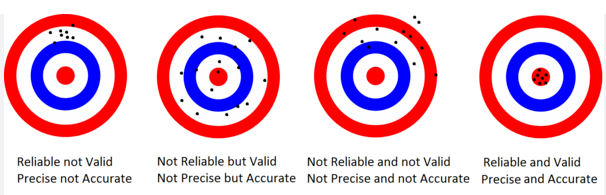
Visual Aids to Understand differences and similarities of terms:
Reliable, Not Reliable, Precise, Not Precise, Accurate, and Not Accurate
The Rate of XPS Publications Increased Almost Exponentially Recently Unfortunately, the reliability of the BEs and Chemical State Assignments Fell Dramatically. WHY? This huge increase shows the utility of XPS, the ease of use of modern systems, but, this huge increase is plagued by the near absence of adequate training on the limits of XPS and the proper data processing and interpretation.

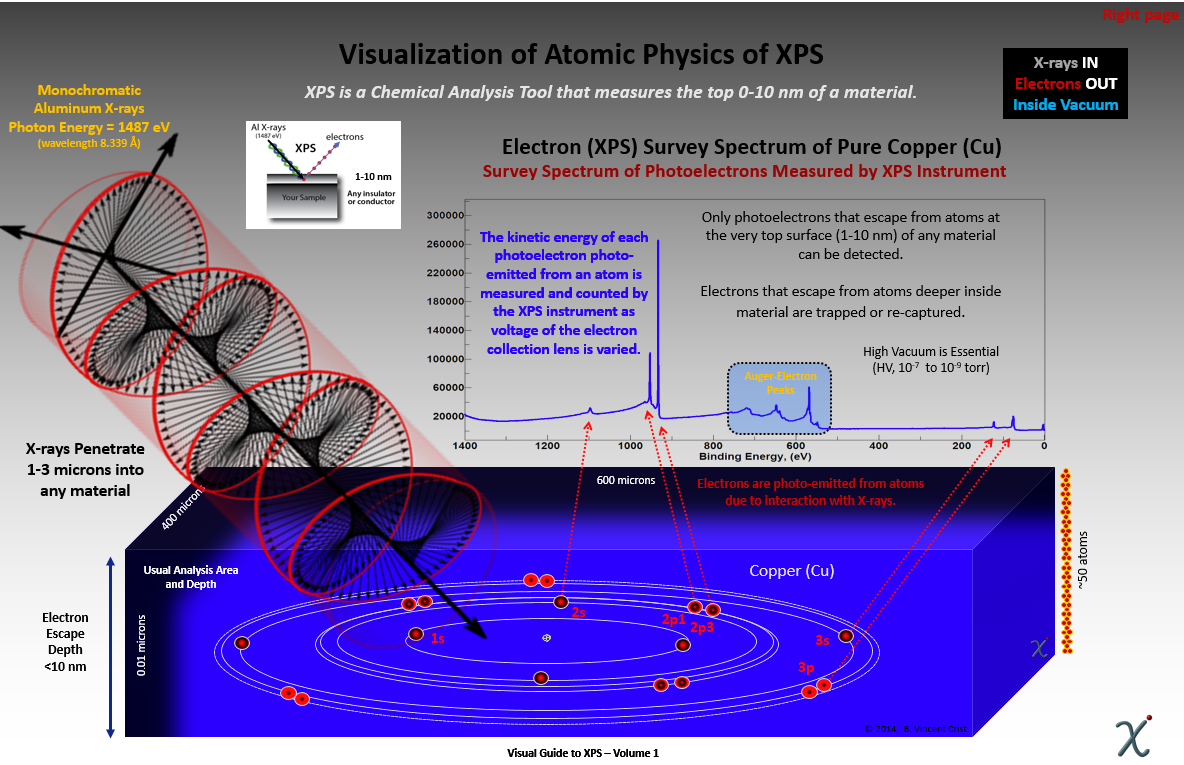
Schematic of Basic Physics of XPS
CEO of XRI B. Vincent Crist



Testimonials