

Charge Compensation affects BEs and FWHMs
“Surface Charging”
Quote from: Wolfgang Pauli
Wolfgang Pauli once stated that “the surface was invented by the devil.”
Maybe he anticipated the troubles caused by surface charging! In the real world there are two major types of charging: Surface Charging and Bulk Charging. XPS has to deal with surface charging effects, and only rarely with bulk charging effects.
The “Charge Compensation” schematic below depicts a few of the factors and variables that exist at the surface of a non-conductive sample when a low voltage (1-10 eV) beam of electrons is used to flood onto the surface to modify the charge that exists on the surface of the sample while it is simultaneously irradiated with a beam of monochromatic X-rays.
A list of the factors and variables that contribute to surface charging are shown below this schematic, along with brief descriptions of charge compensating systems. For XPS, we mainly deal with Surface Charging effects. Bulk Charging effects do not normally affect XPS measurements.
Charge Compensation is also known as Charge Control and Charge Neutralization.
The terms Control and Neutralization are not accurate terms to describe the process,
so these terms are used less frequently.
xxx
- Variables that affect Surface Charging, and Methods to Compensate Charging
- Argon ions and electron gun
- Beam position effect
- Beam size effect
- Charge induced peak broadening
- Charge compensation
- Contamination on sample
- Contamination on sample mount
- Contamination of ball bearing in stage
- Curved nature of sample
- Dielectric nature of the surface
- Differential charging: horizontal
- Differential charging: vertical
- Dual beam charge compensation system (electrons with Argon ions)
- Edge effect
- Electron flood gun alignment
- Electron gun operation
- Electron induced degradation
- Geometry of flood gun
- Incident angle of X-ray beam (grazing)
- Magnetic lens repeller system
- Metal masks
- Metal mesh screens
- Oxidation on ball bearing in stage or mount
- Positioning effect
- Sample effects
- Sample grounding
- Sample shape effect
- Sample size effect
- Sample roughness
- Stage grounding
- Structure of surface
- Surface smoothness effect
- Vacuum effects (gases)
aaaa

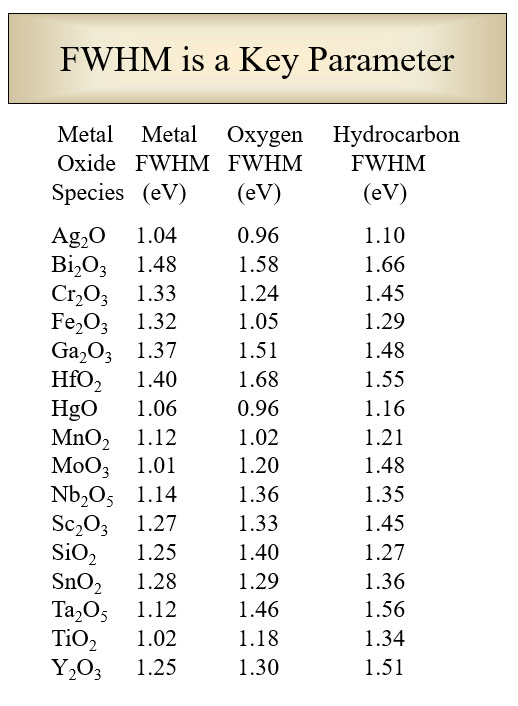
FWHM of C (1s) serves as an Indicator of the Quality of Charge Compensation

Example of Poor Charge Compensation and a Solution

Charge Compensation using Low Voltage (0-10 eV) Electron Flood Gun

An Easy Solution to Poor Charge Compensation

Make sure Flood Gun is Properly Aligned using Poly-propylene

Make sure Flood Gun is Properly Aligned using Teflon

After collecting useful Spectra from a Non-Conductive Sample, we must correct for the charge,
aka Charge Reference


An artistic depiction of normal uncontrolled surface charging with a flood gun turned on.