

Definition excerpted from Wikipedia page “Chemical State”:
The “Chemical State” of a chemical element is due to its electronic, chemical and physical properties as it exists in combination with itself or a group of one or more other elements. A chemical state is often defined as an “oxidation state” when referring to metal cations. When referring to organic materials, a chemical state is usually defined as a chemical group, which is a group of several elements bonded together. Material scientists, solid state physicists, analytical chemists, surface scientists and spectroscopists describe or characterize the chemical, physical and/or electronic nature of the surface or the bulk regions of a material as having or existing as one or more chemical states.
The chemical state set comprises and encompasses these subordinate groups and entities: chemical species, functional group, anion, cation, oxidation state, chemical compound and elemental forms of an element.
Significance
The chemical state of a group of elements, can be similar to, but not identical to, the chemical state of another similar group of elements because the two groups have different ratios of the same elements and exhibit different chemical, electronic, and physical properties that can be detected by various spectroscopic techniques.
A chemical state can exist on or inside the surface of a solid state material and can often, but not always, be isolated or separated from the other chemical species found on the surface of that material. Surface scientists, spectroscopists, chemical analysts, and material scientists frequently describe the chemical nature of the chemical species, functional group, anion, or cation detected on the surface and near the surface of a solid state material as its chemical state.
To understand how a chemical state differs from an oxidation state, anion, or cation, compare sodium fluoride (NaF) to polytetrafluoroethylene (PTFE, Teflon). Both contain fluorine, the most electronegative element, but only NaF dissolves in water to form separate ions, Na+ and F−. The electronegativity of the fluorine strongly polarizes the electron density that exists between the carbon and the fluorine, but not enough to produce ions which would allow it to dissolve in the water. The carbon and fluorine in Teflon (PTFE) both have an electronic charge of zero since they form a covalent bond, but few scientists describe those elements as having an oxidation state of zero. On the other hand, many elements, in their pure form, are often described as existing with an oxidation state of zero. This is one of the attributes of nomenclature that has been upheld over the years.
The difference in Electronegativity Values for adjacent atoms is the dominating effect on Chemical Shifts and Chemical State BEs.
Closely related nomenclature
The chemical state of an element is often confused with its oxidation state. The chemical state of an element or a group of elements that has a non-zero ionic charge, e.g. (1+), (2+), (3+), (1-), (2-) (3-), is defined as the oxidation state of that element or group of elements. Elements or chemical groups that have an ionic charge can usually be dissolved to form ions in either water or another polar solvent. Such a compound or salt is described as an ionic compound with ionic bonds which means that, in effect, all of the electron density of one or more valence electrons has been transferred from the less electronegative group of elements to the more electronegative group of elements. In the case of a non-ionic compound the chemical bonds are non-ionic such meaning the compound will probably not dissolve in water or another polar solvent. Many non-ionic compounds have chemical bonds that share the electron density that binds them together. This type of chemical bond is either a non-polar covalent bond or a polar covalent bond.
A functional group is very similar to a chemical species and a chemical group. A chemical group or chemical species exhibits a distinctive reaction behavior or a distinctive spectral signal when analyzed by various spectroscopic methods. These three groupings are often used to describe the groups of elements that exist within an organic molecule.
“Chemical Names” that describe the Chemical State of a group of elements
The following list of neutral compounds, anions, cations, functional groups and chemical species is a partial list of the many groups of elements that can exhibit or have a unique “chemical state” while being part of the surface or the bulk of a solid state material.
| Metal oxide Metal hydroxide Metal carbonate Inorganic carbonate Fluoro-ether Organofluoride Organic type chlorine Inorganic type chlorine Trifluoromethyl Difluoromethyl Benzyl group Phenyl group Carbonyl bond Ether Group Alcohol bond Organic acid Double bond | Triple bond Inorganic acid Organic ester Metal ester Organic carbonate Nitrile group Cyanide ion Perchlorate ion Sodium ion Lithium ion Magnesium ion Calcium ion Lead ion Sulfate ion Phosphate ion Silicate group Stannate group | Halide ion Fluoride ion Chloride ion Bromide ion Iodide ion Chalcogenide group Sulfide group Halide group Metal sulfide Organic sulfide Metal selenide Telluride Nitride Nitrite ion Nitrate ion Phosphide Arsenide | Antimonide Silicide Silicate Gallate Germanate Tungstate Niobate Ferric ion Ferrous ion Ferride Ferrate Rhenate Mercurous Mercuric ion Mercurate Thallate Thallic ion |
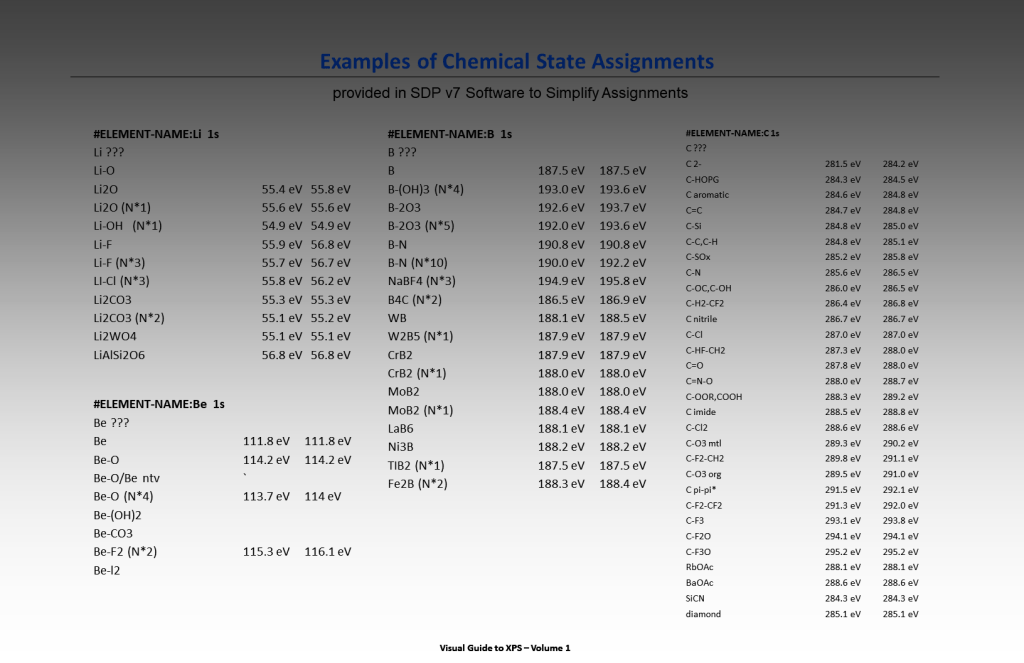
BEs assigned to Chemical States of Elements: Li, Be, B, and C (Yhe XPS Library)
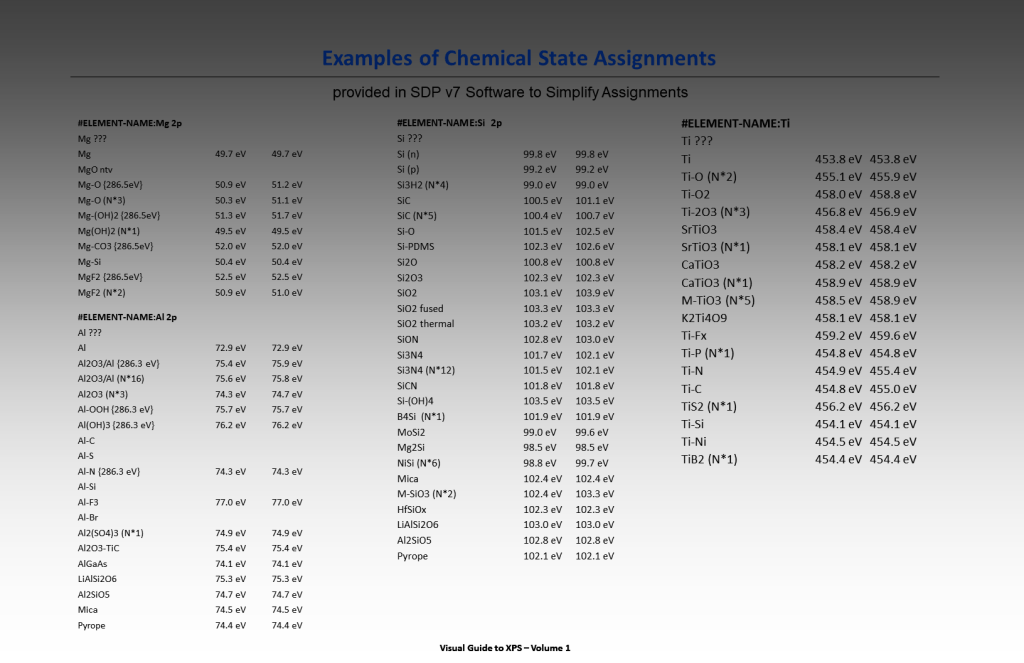
BEs assigned to Chemical States of Elements: Mg, Al, Si, and Ti (The XPS Library)
Chemical State BE Table in PHI Handbook

Chemical State BE Table in NIST SRD-20 Database

Chemical Shift Values in Beamson & Briggs Book

Chemical Shift
The ISO definition for “Chemical Shift” is:
“the change in peak energy arising from a change in the chemical environment of the atom“
The book titled “Surface Analysis by Auger and X-ray Photoelectron Spectroscopy” includes a chapter on “Chemical Effects in XPS” written by Laszlo Kover which provides a similar definition for Chemical Shift:
“The difference in the energy positions of the photoelectron or Auger peaks, as a consequence of the change in the corresponding electron binding energies (BEs) according to the different chemical environemnt of the atoms emitting the signal electrons, is called “Chemical Shift”.
The book titled “Photoelectron Spectroscopy” writtent by S. Hufner describes chemical shift as: “In the investigation of molecules and solids, one is not usually interested in the absolute binding energy of a particular core level, but in the change in binding energy between two different chemical forms of the same atom. This energy difference is called the chemical shift.”
Each definition forgets to mention the Energy to which the Chemical Shift is referenced. That reference energy is usually the BE of the pure element, usually in the solid state, which is often normalized to Zero (0 eV). As a result Chemical Shifts are small numbers (0.0 to <10) that can be positive (+) or negative (-). In theoretical results Chemical Shift values are usually plotted as Relative Energy Shifts or Relative Binding Energies where Zero (0 eV) is the normalized BE of the pure element in solid state form.
The inherent difficulty in using “Chemical Shifts” or “Chemical State BEs” is due to the problems associated with charge referencing non-conductive insulators and semi-conductors. In practice most XPS analysts will report Chemical State BEs instead of chemical shifts because the Chemical State BEs are characteristic of specific electronic states for each element.
Example of Chemical Shift Values reported as Relative Binding Energies.

Example of Chemical Shift Values with Chemical State BEs
