Accuracy, Reproducibility and Uncertainty as reported by NIST (USA) and NPL (UK) in 1990.
Published in JVST A, Vol 8, p 735 (1990) by C. J. Powell and M. P. Seah
(2) Accuracy of measurement:
The closeness of the agreement between the result of a BE measurement and the (conventional) true BE value of the measurand.
(4) Reproducibility of measurements:
The closeness of the agreement between the results of BE measurements of the same measurand, where the individual measurements are carried out changing conditions such as: method of measurement, observer, measuring instrument, location, conditions of use, time. Reproducibility may be expressed quantitatively in terms of the dispersion of the results, for example the standard deviation of the BE.
(5) (Absolute) error of measurement: The result of a BE measurement minus the (conventional) true BE value of the measurand.
(12) Uncertainty of measurement: An estimate characterizing the range of BE values within which the true BE value of a measurand lies
A Review titled:
XPS in industry—Problems with binding energies in journals and binding energy databases by B. Vincent Crist. Journal of Electron Spectroscopy and Related Phenomena 231 (2019) 75–87
Abstract
Experimentally measured BEs are commercially available in various forms, e.g. scientific journals, hand-books, internet based data-banks, computer-based data-banks of BEs or complete sets of actual spectra. This review addresses fundamental problems that exist in experimentally measured binding energies (BEs) stored in various numerical X-ray Photoelectron Spectroscopy (XPS) data-banks, including, for example: (1) PHI Handbook of XPS (1979), (2) NIST SRD-20 XPS Database, v1.0–4.1 (1989–2017), (3) Wiley Practical Surface Analysis 1st and 2nd ed. (1990), (4) SASJ ComPro v12 and Data-bank (1990–2017), (5)JEOL Handbook of XPS (1991), (6) CRC Practical Handbook of Spectroscopy (1991), (7) PHI Handbook of XPS, 2nd Ed. (1992), (8) AVS Surface Science Spectra (1993–2017), (9) LaSurface Web Site Database – XPS (2001–2017), and (10) Biesinger XPSfitting website (2012–2017).
The 3 major problems in all existing data-banks are due to: (a) the widespread use of different calibration energies, (b) the widespread use of different energy scales, and (c) the widespread use of a “user-defined” BE for the C 1s peak attributed to hydrocarbon moieties. At the end of this review there is a list of recommendations for the design and content of future XPS data-banks.
Mean BEs, Standard Deviation of BEs, and Ranges in BEs
from XPS Binding Energies in NIST SRD-20 Database
(Number of Measurand Values = # of Values)
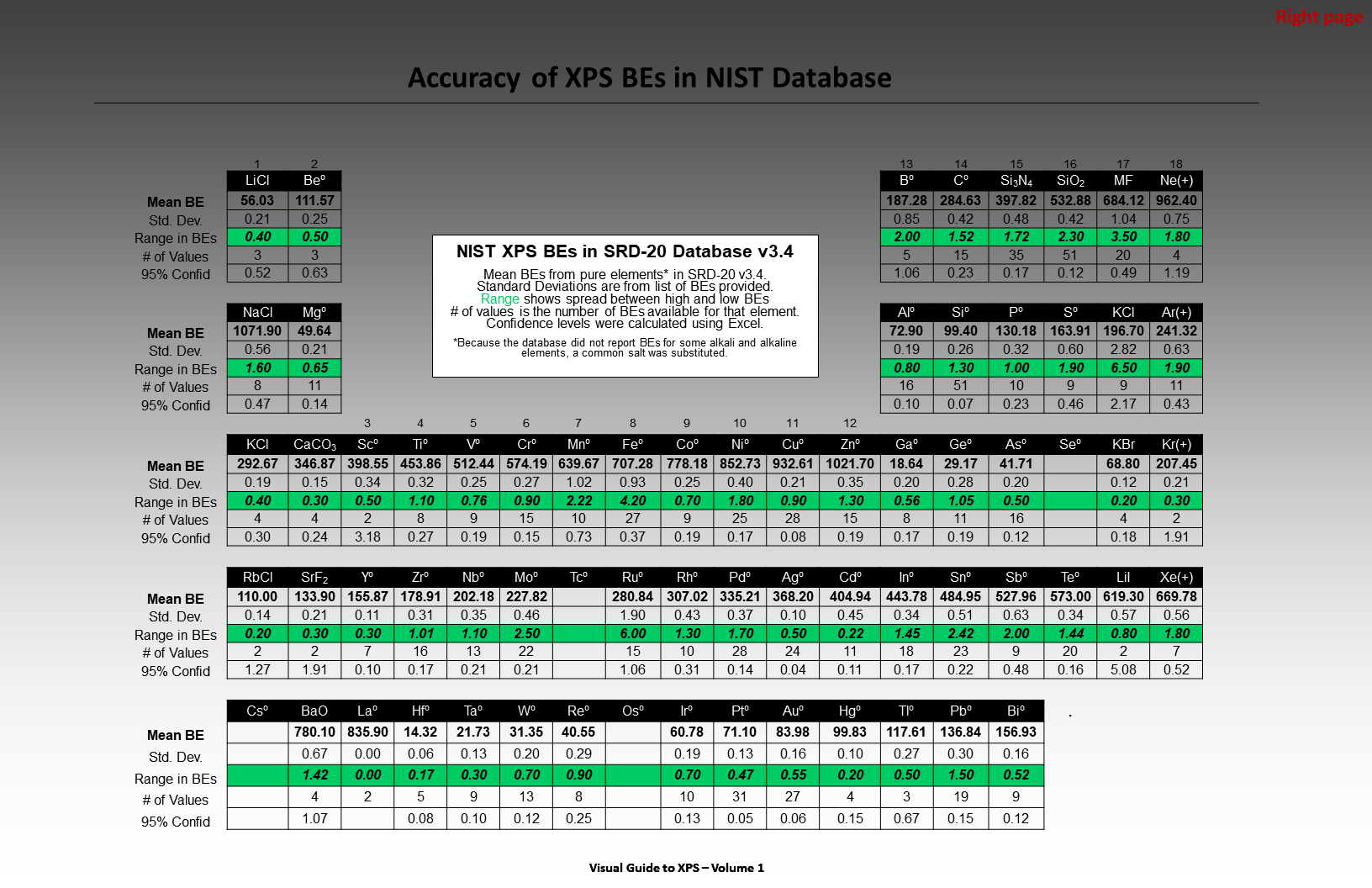
The following histograms are a subset of the many histograms that characterize the XPS BE measured from pure elements and pure metal oxides used by industry. The original BE histograms can be found in “The XPS Library” website.
Large Standard Deviation values indicate more uncertainty in the Mean BE.
Smaller Standard Deviation indicates less uncertainty in the Mean BE.

Histogram of 24 different Ag (3d5/2) BEs from Pure Ag in NIST Database of XPS BEs Standard Deviation is 0.09872

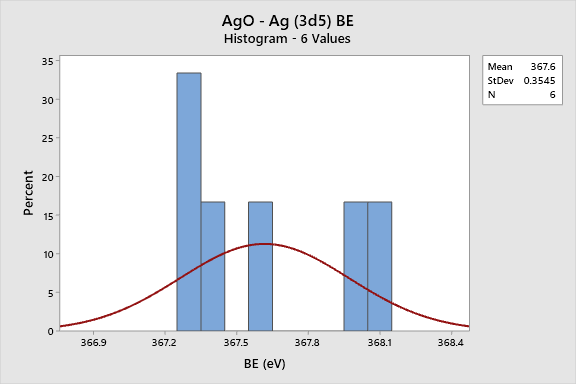
Histogram of 6 different Ag (3d5/2) BEs from AgO in NIST Database of XPS BEs
Standard Deviation is 0.3545
Histogram of 15 different Al (2p) BEs from Al in NIST Database of XPS BEs
Standard Deviation is 0.1918

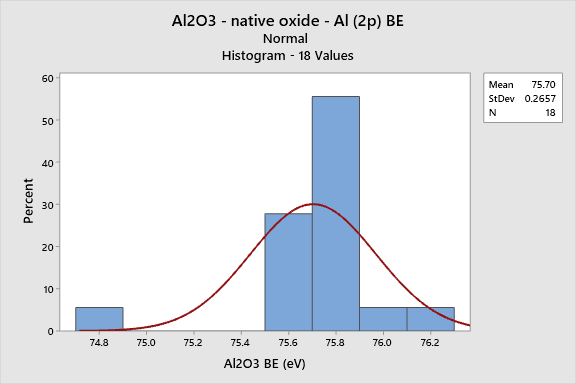
Histogram of 18 different Al (2p) BEs from Al2O3 in NIST Database of XPS BEs
Standard Deviation is 0.2657
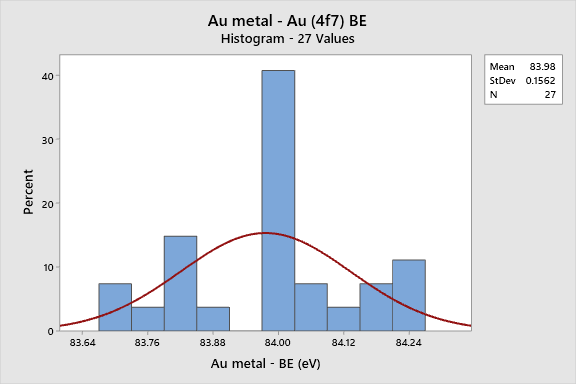
Histogram of 27 different Au (4f7/2) BEs from Au in NIST Database of XPS BEs
Standard Deviation is 0.1562
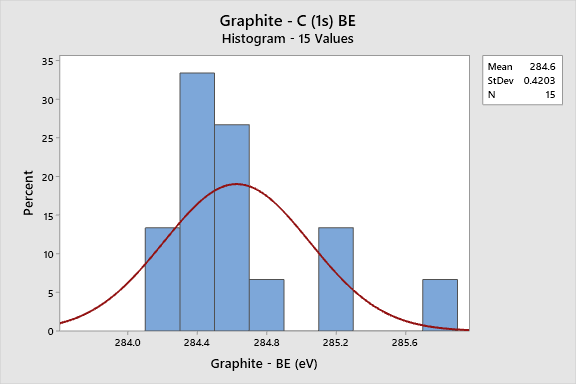
Histogram of 15 different C (1s) BEs from Graphite in NIST Database of XPS BEs
Standard Deviation is 0.4203
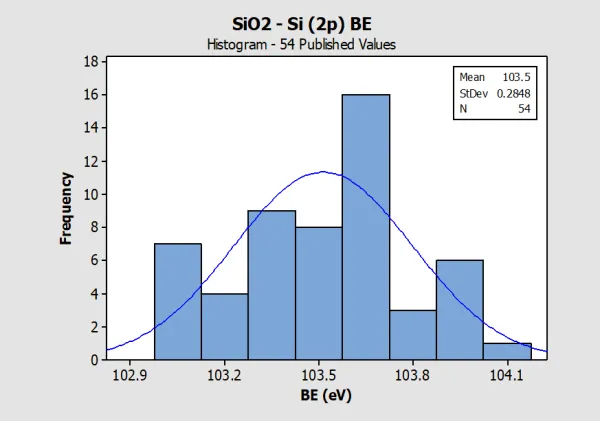
Histogram of 54 different Si (2p) BEs from SiO2 in NIST Database of XPS BEs
Standard Deviation is 0.2848