Assigning Chemical States to Peaks in Peak-fits requires several types of information before you start the actual peak-fitting process. The information you need to have or consider BEFORE starting any peak-fit is:
- a table of reliable chemical state binding energies (BEs) to assign to the XPS peaks being produced
- the number of peak maxima and inflection points that constitute probable peaks
- a list of expected or probable chemical states and their BEs
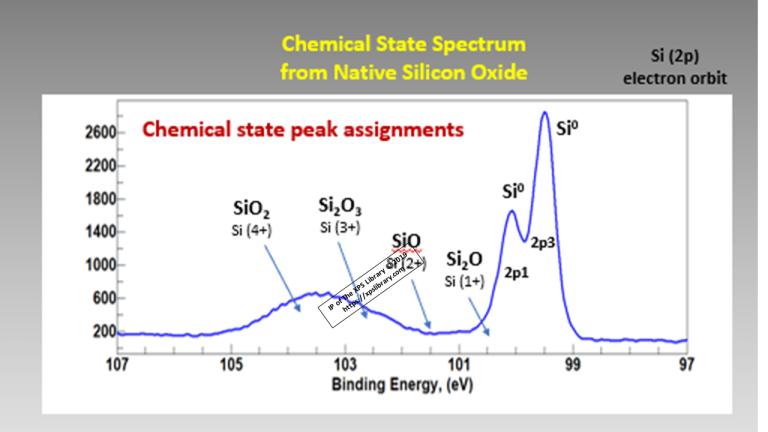
- the expected chemical shifts for this XPS signal (e.g. 0.5 eV or 1.0 eV per oxidation state)
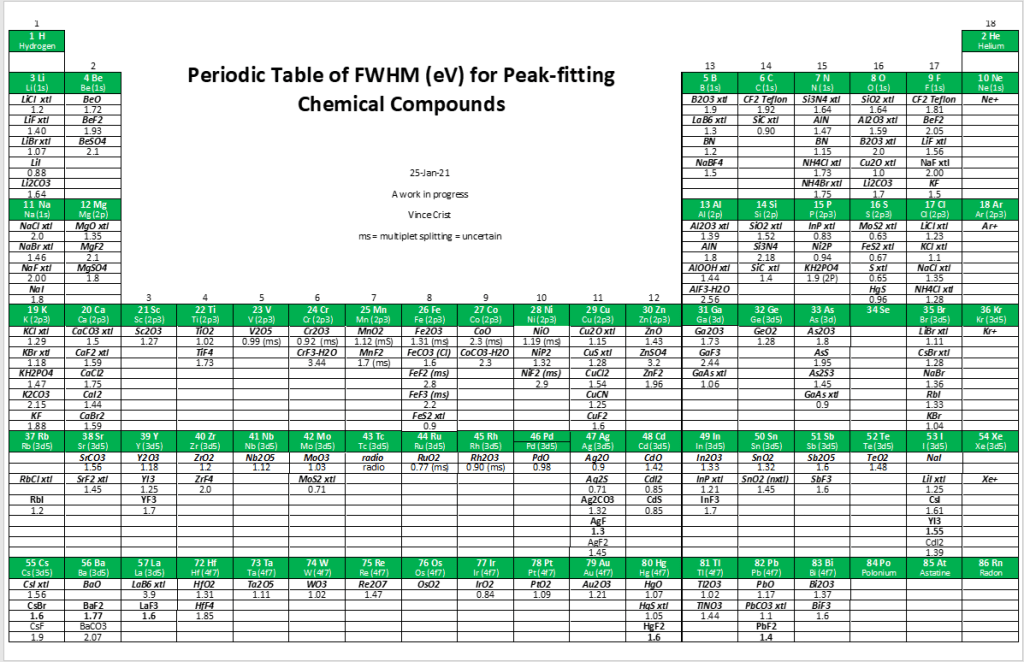
- a list of known or reasonable FWHM values (peakwidths) for the different chemical states
- if significantly different FWHM are used, then why are they different
- the peak-shape(s) to be used (e.g. 90:10 Gaussian:Lorentzian, or 85% Voigt)
- if different peak-shapes are used, then why are they different
- the type of baseline (background) to be used (iterated Shirley, Tougaard, other)
- the endpoints of the baseline (does baseline include all excited state signals?)
- the number of endpoints to be averaged (usually 3-5)
- the chemical state binding energy (BE) of the C (1s) peak used to reference the BEs
- the energy scale correction (shift) value used to adjust C (1s) to 285.0 or 284.9 eV
- the BE difference between the spin-orbit peaks if present
- the peak area ratio between the spin-orbit peaks if present
- the approximate empirical formula for the substrate material for balancing the chemistry
Smoothing chemical state spectra is never recommended. If you need to resolve small differences, then you need better Signal/Noise which means more scans.
When we need to resolve the chemistry of the O (1s) peak envelop (signal) we need to be careful. The O (1s) signal can appear as a simple symmetrical peak or a complex set of resolved peaks. Due to the presence of hydroxides, suboxides and hydrates, it is often difficult to peak-fit the O (1s) peak envelop. Because the O (1s) peak is often symmetrical and broad, it can be fit with one broad peak or resolved into 3 different chemical state peaks. This is the reason that we need to use known or reasonable FWHM, which might be applied to each of the 3 peaks. A list of common FWHM is a valuable collection for peak-fitting.
Identifying chemical states from peak-fits is one of the key uses of XPS. There are many publications and a few databases of BEs that have been assigned to chemical states published by thousands of professors. Unfortunately most of those BEs have uncertainties that are large enough to cause the wrong assignment of chemical states. The NIST database if BEs and the PHI handbook are filled with BEs that have large uncertainties. For this reason, recent professors have collected their own small databases from chemicals related to their particular research.
When peak-fitting it is best to use the minimum number of peaks and to use the same FWHM for all of the peaks unless one of the peaks is due to a pure element. In other words: Do not too many peaks. Do not use really Fat or Skinny peaks.
The following images and tables will help you to review the many variables that need to be considered BEFORE collecting any chemical state spectrum.
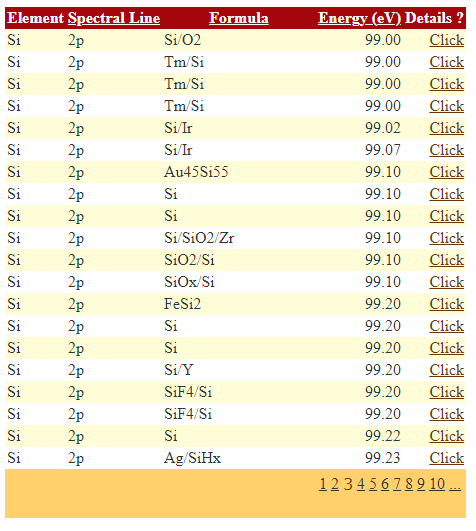
Assigning Chemical States from a BE Lookup Table
It is very important to note that when 2 different states overlap the scientist must chose the state that is logical based on the other elements contained in the sample.
Be careful. It is easy to make a mistake so be sure of your choice.

Chemical State Lookup Table used to Assign Chemical States

Periodic Table of FWHM (eV) for Peak-fitting Chemical Compounds
Chemical State Steps (~1 eV/state), Chemical Shifts, and Oxidation Step Shifts

Chemical States Expected from a Native Silicon Oxide
FWHM from Pure Metals / Elements for Mono and Non-Mono X-ray Sources

Chemical State BE Table from PHI Handbook

Table of Chemical State BEs from the NIST SRD-20 Database of BEs
Use as a guide with Great Caution because the BE uncertainties are large.
Uncertainties can be 0.4 eV for conductors, and as much as 1.5 eV for insulators.

Table of Chemical State BEs from the NIST SRD-20 Database of BEs
Use as a guide with Great Caution because the BE uncertainties are large.
Uncertainties can be 0.4 eV for conductors, and as much as 1.5 eV for insulators.